
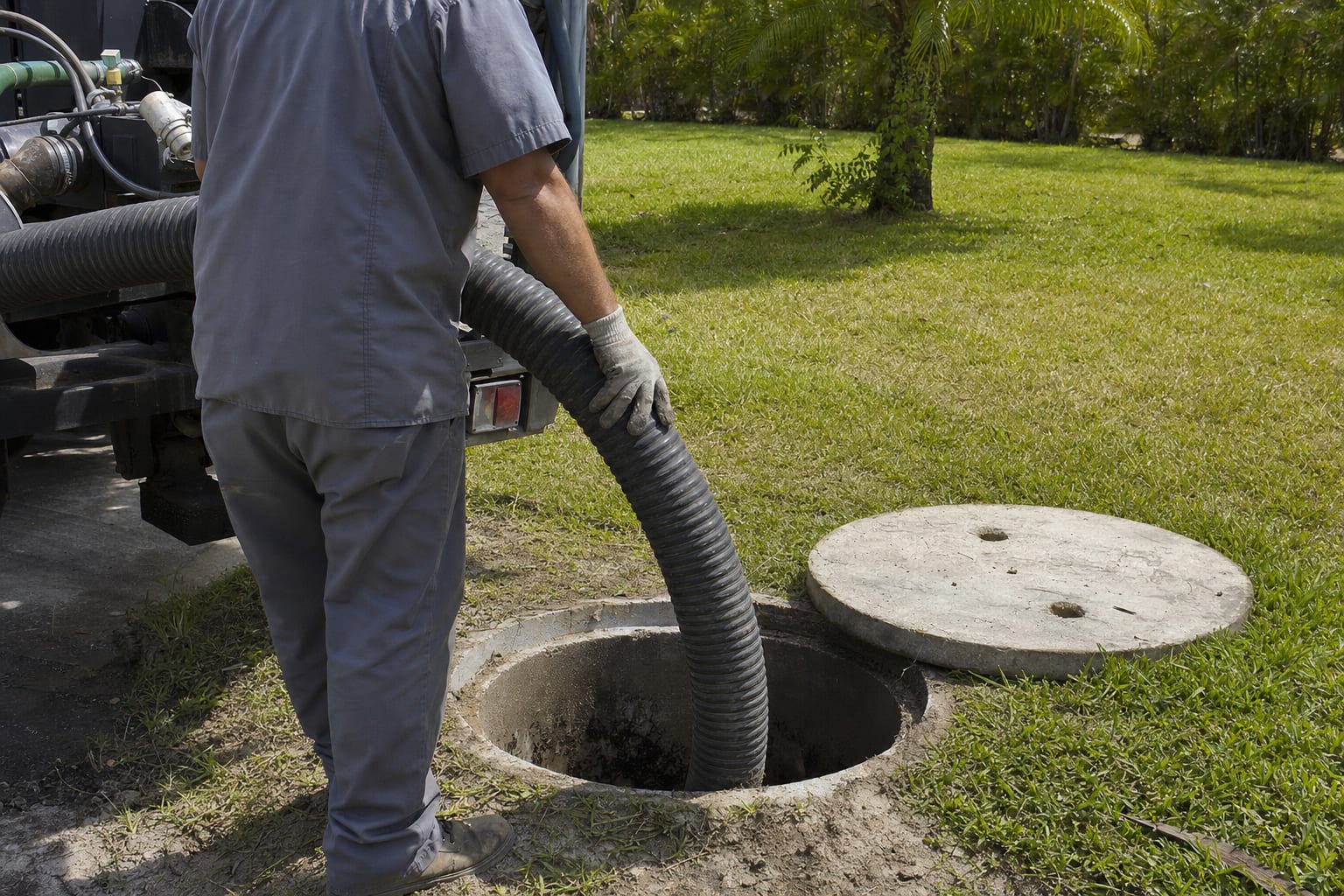
What a complete residential pump-out should address
The objective is to remove accumulated liquid, scum, and settled solids through an appropriate access opening. Tank size, compartment layout, lid condition, and hose distance all affect the visit. A small inspection port may not give the same working access as a service opening. If the lid is buried, agree in advance on who locates and exposes it and how the lawn will be left afterward.
While the tank is open, the contractor can note visible concerns such as a deteriorated cover, displaced baffle, high liquid level, or an effluent filter that needs service. That observation is useful but is not a guarantee about every buried pipe or the disposal field. Ask for the pumped volume and where the septage will be taken.
Maine guidance uses a range, not a universal deadline
Maine CDC advises pumping about every 2–5 years depending on use, and annually when a garbage grinder is used. Household size, tank capacity, water use, and the amount of nondegradable material entering the system change the interval. A new owner without records has a different information problem from an owner who has measured sludge and kept every receipt.
Treat the range as maintenance guidance, not as a statewide law requiring every household to pump on the same date. If your site evaluator, manufacturer, municipal program, or operating agreement sets a more specific interval, follow the instruction that applies to that system. Garbage grinders add solids quickly, which explains Maine CDC's shorter annual recommendation for those homes.
Primary source: Maine CDC Subsurface Wastewater Disposal Rule.
Transport is part of the job
Maine licenses each conveyance carrying Category C septage through the Maine DEP Non-Hazardous Waste Transporter Program. Program materials describe a driver-side window decal, a license kept with the conveyance, and shipment records. This site does not publish a credential number because no assigned contractor has been selected when you read the page.
Ask the contractor to identify the authorized receiving or disposal facility for the load. Maine law now sharply limits new septage land-application licensing, so a vague claim that waste is spread somewhere is not enough. A clear destination and a pump-out record make maintenance history more useful for the next service call or property transaction.
Primary source: Maine DEP non-hazardous waste transporter program.
Planning a septic tank cleaning call
Have the property address, best callback number, system records, last service date, and a plain description of the current condition ready. Mention buried lids, gates, ferry access, steep or soft ground, long hose distance, snow storage, and any alarm. The assigned contractor, rather than this website, confirms availability, scope, price, and whether the job fits its equipment.
Portland itself is substantially sewered, so begin by confirming that the parcel uses an onsite system. Island properties and isolated outer parcels can have septic records even while the dense mainland relies on municipal collection. Nearby towns have their own mixtures. A neighborhood name or ZIP code is not proof of wastewater service.
Credential and disposal questions are reasonable
Maine DEP licenses each conveyance used to transport Category C septage. Program materials call for a decal on the driver's side window, a license kept with the conveyance, and shipment records. Pumped material goes to an authorized receiving or disposal facility; ask the assigned contractor to name the destination for your load.
This lead-routing site does not assign a credential number to itself and does not imply ownership of a truck. Ask the contractor who accepts the call to identify the business performing the work, explain relevant licensing or subcontracting, show current insurance if that matters to your project, and state where pumped material will go.
Primary source: Maine DEP non-hazardous waste transporter program.
After the visit
Keep a record of the date, work completed, pumped quantity when applicable, components accessed, observations, destination, and recommended follow-up. Mark access points on a property sketch using fixed measurements. If a problem requires design or permitting, record exactly what the contractor observed and take that information to a licensed site evaluator or the Local Plumbing Inspector.
A useful invoice describes work rather than making broad promises about the future. Ask questions while the condition is visible, and do not allow required inspection stages to be covered early. For recurring symptoms, compare notes across visits so the next professional sees a timeline instead of one isolated episode.